


Former Mayor Lovely Warren Pushes Back on Rochester Red-Light Camera Debate

Former Rochester Mayor Lovely A. Warren is weighing in on Rochester’s renewed debate over red-light cameras, arguing the city’s own data does not support claims that the technology consistently improves public safety.
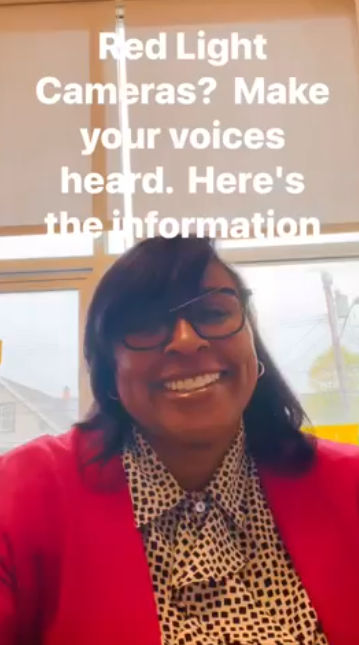
In a recently posted social media video, Warren criticized city officials for citing New York City statistics during recent public discussions instead of relying on Rochester’s own historical data from the city’s former red-light camera program.
“I was a little bit taken back by the fact that data that was presented yesterday was presented from New York City and not from Rochester,” Warren said. “When we have data from Rochester — actually we have a whole report that was done about red-light cameras.”
Rochester previously operated a red-light camera program during Warren’s administration before the city dismantled it in 2016. Warren said the program was reevaluated using data collected from 32 intersections and 48 cameras across the city.
The former mayor also accused the city of removing the report from its website, calling the move “disheartening” and “misleading to people that want to research this information and want to know the truth.”
The debate over automated traffic enforcement has resurfaced amid increasing complaints from residents about reckless driving, speeding, drag racing, and dangerous intersections throughout Rochester neighborhoods. Some city officials and safety advocates have argued that red-light cameras could help reduce crashes while limiting the need for police traffic stops.
But Warren said Rochester’s own data paints a far more complicated picture.
“Supporters will point to the headline that there was a total crash reduction of about 21%,” Warren said. “But averages can be misleading because they hide what’s really happening on the ground.”
According to Warren, several intersections experienced increases in crashes even after cameras were installed.
“Twenty-five percent of our intersections — that’s one in four — actually saw crashes go up because of red-light cameras,” she said. “And over 28%, nearly three in 10, saw increases in the most dangerous crash types.”
In the video —posted on Facebook — Warren cited intersections including State Street and Jay Street, St. Paul Street and Upper Falls Boulevard, and Westridge Road and Ridgeway Avenue as locations where crashes or injuries reportedly increased.
Warren also challenged the argument that cameras significantly improve driver behavior.
“At Clinton and Norton, violations increased nearly 44%. At Dewey and Ridgeway, they increased more than 50%,” she said.
Beyond the safety debate, Warren framed the issue as one of economic fairness, arguing automated enforcement disproportionately affects low-income residents.
“Who does that bill impact the most?” Warren asked. “Not the person who can easily pay it. It impacts the working parent, the senior on a fixed income, and families already stretched thin.”
“For them, a $50 or $100 ticket is not small,” she continued. “It means groceries, it means medication, it means gas, it means how do I get to work?”
Warren argued the city should instead focus on infrastructure improvements such as road design changes and signal upgrades rather than automated enforcement systems.
“If our goal is safety, then we should invest in what we know works better — street design, improved signals, and proactive solutions, not automated enforcement,” she said.
She also accused officials of prioritizing revenue generation over public safety.
“What I know for a fact is that revenue is driving the decision and not safety,” Warren said. “At this point, with the data that we already know, it can no longer be about safety. It has to be about balancing the budget on the backs of poor people.”
The renewed conversation over red-light cameras comes as Rochester continues broader discussions surrounding public safety, policing, and traffic enforcement. The Rochester Police Accountability Board has faced ongoing legal and operational challenges, while city officials continue searching for ways to address reckless driving complaints without increasing tensions surrounding traditional traffic stops.
Mayor Malik D. Evans has not announced a formal proposal to reinstate red-light cameras, though discussions surrounding automated enforcement and traffic safety strategies have intensified in recent months.
Warren closed her remarks by urging residents to focus on Rochester-specific evidence rather than comparisons to larger cities.
“Look at Rochester data, not New York City data,” she said. “It tells the true story about Rochester, New York.”


Comments